Sunday, December 13, 2015

Role of a Community Manager

I often come across people who think the role of a community manager is to manage the social networks of a company/brand! Little do they realize that the role of a community manager goes way beyond managing social networks of a company/brand. 
Community manager is the "human" behind the brand who talks to its audience online.
That doesn't mean their role is restricted to posting updates & engaging with the audience on various social platforms. 
An informed community manager:
  • Uses social listening & analytic tools to track conversations around the brand & industry
  • The analysis of such conversations can help businesses take informed decisions for their content or marketing strategy
  • Ensures that the community grows and stays vibrant; makes new members feel at home and enforces rules of engagement
  • Creates a platform of conversation to help marketers engage with desired target audiences
  • Helps build relationships within the community and between the company and community. Some community managers plan events, run forums and more
Strengthen relationship beyond a virtual handshake
A community manager strengthens relationship with it's audience/customers beyond a virtual handshake. Listening and responding genuinely plays a big part in strengthening relationships. We strive to deepen relationships one-on-one as we're so grateful for each customer and friend. It's important for a community manager to be personable and not just act like a machine responding to its customers/audience.
It's so great when a company can "come to the rescue" in times of frustration
Surprise & delight the community
It's imperative for a community manager to go beyond the screen! A simple 'Thank You' note is more powerful than just connecting virtually. Such initiatives cement a brand's place in people's mind and are shared & treasured by all! Surprise and delight is all about strengthening the one-on-one interactions with intangible ROI. 
While a community manager does all the above to manage and build a strong community, a company's values also contribute to the well-being of a community.  
If you have a culture of collaboration, your company will succeed for better. 
Managing a community, keeping them engaged, surprising & delighting them at all times isn't an easy task. Community managers face challenges in their roleto create a close knitted and strong community: 
  • Time management - is the biggest problem for community managers. Not only do they manage the brand pages but also listen to what their fans and followers have to say about them. Solid listening tools can help ensure that the community manager is able to respond to all the great mentions. It can help to have different team members "own" different areas/platforms so they ensure all mentions are covered
  • Content strategy - community managers have to prepare content that appeals to various segments of audiences, creating unmatched value proposition for all 
Trust your intuition and be yourself while building a community.  Take the time to invest in one-on-one relationships by listening, responding, sending gifts (of any kind!). Continue to care & share, tweet by tweet & post by post! 
Note: This topic was discussed during the #SocialPowWow Twitter chat and the full transcript can be read here: https://goo.gl/sEMwi0 

Friday, December 11, 2015

The Power of Community Building & How it can Benefit your Business

A community is real or virtual place where everyone with similar thoughts come together to discuss about a subject they are passionate about. Communities share their ideas, experiences and learn from each other on an on-going basis. An online community is a group of people with similar goals, interests, passion to connect & exchange information digitally. Thanks to social media that communities aren't restricted geographically anymore but are now global!
Build community with a purpose
Community building starts by understanding the needs and wants of your community. Who, why, what? Take time to understand who you will connect with & who is connecting with you already AND why you are building a community. 
Find that common thread of interest & bring them on a platform that lets them contribute to it effectively! Once you really know who your community is, you can begin to think about how you can benefit one another.
Importance of community building for your business 
Every business needs a community. Advocacy is key purpose for marketers; one of the most potent long term goals attained via community building! 
Those who regularly interact with a brand are the ones who share and spread content, recommend your brand and are repeat customers. When you invest in your community, you invest in the future and are ready to build a better business together.
Powerful community have positive impact on your business
Brands + communities have the power to bring change together and make positive ripples in this world together! It is the first defensible asset if something goes wrong. A powerful community will ALWAYS stand by you. 
Communities definitely impact your bottom line with word or mouth. Give them something to love you for, make it positive!
It spreads your word around, protects you when you're facing crisis, becomes a sources of ideas and content.
So start building your community today if you haven't yet! 
Note: This topic was discussed during the #SocialPowWow Twitter chat and the full transcript can be read here: https://goo.gl/z2NTtY  

Tuesday, November 3, 2015

#SocialPowWow: Share, NOT Save Knowledge

I have always believed in the power of community and over time have formed a community of like minded people who share similar interests.
“Power is gained by sharing knowledge, not hoarding it”
That said, I recently started a Twitter ch #SocialPowWow. The idea behind the chat was to build a community:
  • For Indian Entrepreneurs, Marketing, PR, Advertising and Digital professionals
  • To exchange ideas and start discussions around topics to explore endless possibilities that are transforming the world of business
Till now, five chats have been successfully hosted on Twitter and the response has been superb! Here’s a list of topics we have covered so far and in case you haven’t check out the chat as yet, please do give a read to the re-cap:
  • Social Media for Public Relations & Strategic Communications
With our special guest Vikram Kharvi, Senior Group Head, lead B2B & Tech Practice @AdfactorsPR, the chat received a great response from the PR & digital marketing professionals in India and globally. The chat focused on the role social media plays in strategic communication, especially for those in PR, how social media can be beneficial in PR crisis management and best practices for PR teams in managing brand position on social media. Here’s the full transcript of the chat: https://goo.gl/E8x7WH  
  • Content Marketing for Businesses
Olga Andrienko, Head of Social Media at @semrush spoke about content marketing. We all say content is the king and rightly so! How do you create scintillating content for the readers, align content marketing with your business objectives and tools you can use for content creation is what was discussed during this chat. Here’s a quick re-cap: https://goo.gl/Jeppsc
  • Digital Marketing for Startups
The chat with Sorav Jain, Thinker in Chief @echovme was focused around digital marketing for startups, how much should one invest in digital marketing, tools which can be helpful for marketing for startups and much more! Catch the full transcript of the chat here: http://sfy.co/c0nCK  
  • Social Media Analytics
Social media analytics with Shonali Burke, CEO, Shonali Burke Consulting, Inc. was a fun and engaging chat. The chat covered how social media analytics could benefit businesses and clients, how to develop strategies and measure KPIs, challenges faced to get buy-ins from the upper management and the tools that can help in social media measurement. Check out the chat transcript here: https://t.co/jHtasg6zjW
  • Storytelling & Social Media
After an engaging chat with Shonali on social media analytics, we had another insightful chat with her on storytelling & social media. The topic covered the importance of storytelling in social media, focus of brands on storytelling in their campaigns, best practices in storytelling and how customers’ perception play into effective storytelling. To read the full chat transcript, click here: https://goo.gl/gTsZAn
I’m thrilled to have such wonderful and powerful #SocialPowWow community! Always around to exchange knowledge, share ideas, examples and enticing case-studies. Let’s strengthen the community and learn from each other’s experiences. Join us for #SocialPowWow, every Thursday 9PM IST; 11:30AM ET. Look forward to your participation.

Monday, September 28, 2015

The Continuing Evolution of the Indian PR Landscape

As the Indian PR landscape continues to evolve, it is fascinating to see clients adapt to the integration
of digital efforts.

For example, a press event is not restricted to just calling reporters on the ground. It also means creating content for a tweet stream per the flow of the event, and continuously engaging with the reporters online and offline.

Just this past month, #GoogleHouse was a fascinating press event where updates about Google’s new product/features were unveiled. Not only did Google India have a house full of reporters, the hash tag also trended in Mumbai (where the event was held) at #1, and which also saw engagement by the reporters. 

It is equally fascinating that while clients are jumping on board, Indian PR and communications professionals still remain reticent.

According to this IAMAI-KPMG report, India has over 350 million Internet users as of June 2015; this number is expected to increase over 500 million by 2017. With such a huge chunk of the audience online, it becomes increasingly important to reach them outside of the traditional ways of communicating (newspapers/magazines/TV/radio).

Though the “what” to communicate remains constant, the “how” to communicate is constantly changing.

Here are some compelling PR trends executives need to adapt to if they want to stay relevant in the industry in the long run:

1. Building the social profiles of C-suite executives.

C-suite executives have started understanding that their social presence matters. Their customers are online and, in order to connect with them, it is essential that they have a social presence to connect and engage with their target community.

PR executives can play a vital role in positioning and building such social profiles, keeping in mind the customer and media perspective.

2. Multimedia & crisp communication.

A quick crisp e-mail with images or infographic has a better chance of catching the media’s fancy than long pitch notes or press releases. An innovative way of sharing information is what the media looks for.

If you can communicate the message in 140 characters, you’ve nailed it!

3. Online & blogger engagement.

Given the increasing Internet connectivity in India, PR executives need to start interacting with the online and blogger community from various industries to keep themselves and their clients relevant and up-to-date.

While print media still has a wide reach in India, the audience is glued online, and frequently seek feedback about product and services from the online/blogger community.

4. Twitter chats.

The trend of Twitter chats is catching on in India. While these digital events are still primarily held on a one-off basis, many brands have started interacting with their audience through such chats, helping them form a community of evangelists over time.

An interesting example: a Google Twitter chat that invited entries to share an app idea for the Prime Minister’s office. This initiative was undertaken by Google India in collaboration with MyGov.in (compare this to the White House’s We the People effort).

Influencers in the tech blogger space were roped in, along with spokespeople from Google and MyGov.in. The 30 minute tweet chat reached 2.7 million unique users and garnered over 6.3 million impressions on Twitter. Needless to say, #PMOIndiaApp trended in India.

Similar Twitter chat models are being adapted by various companies in India to discuss topical trends in the industry. Usually, they rope in company’s spokesperson and an influencer/celebrity to maximize reach.

In closing

To understand their clients’ industries better, PR executives should start listening to the brands’ communications online. This understanding will go a long way in developing a more effective strategy.

Have you observed any more interesting trends in the communications Industry in India? I would love to know your thoughts!

Image: yourmarketingdepartmentct.com via Google, CC 4.0

Friday, August 7, 2015

Social Journalism - An Informal Way to Communicate?


July 27th 2015 was indeed a sad day for India! The day which started with terrorist attacks
in Punjab early morning followed by the demise of Former president and Bharat Ratna, Dr APJ Abdul Kalam, left most of us in pain and shock!

With the advent of social media, the way we consume news has evolved over time. While I was constantly checking my Twitter feed around both these events, I stumbled upon a Tweet by ‘PressTrust of India’ (PTI), India’s premier news agency which has been functioning since 1949 and it currently commands 90% of new agency market share in India.

To my surprise, the tone of the Tweet by PTI was really disrespectful. The use of words by one of the biggest news agencies in India definitely made me think if social media is taken seriously by the new/media agencies in the country. Instead of a blunt statement, PTI could have utilized 140 characters to share the message in a proper tone giving some respect to the former president of the country.


Within minutes, there were 695 RT’s, 167 Favorites and over 100 conversations around the tone of the Tweet. It was disheartening to see PTI not responding to any of the Tweets proactively. Although, the following Tweets did address him properly.


Here’s a snapshot of the same news posted on their Facebook page. While one can’t edit a Tweet on Twitter...however, the same could have been edited by PTI on Facebook. But the news agency did not bother to do so.


With social media:
●     News channels/publications/wires are running the rat race to deliver the news “First”
●     Not sure if there is a designated Editor or a process designed through which the news is uploaded on the social platforms of the publication/channel/wire. At least in this case, it doesn’t seem that PTI has an Editor to look at the content going on Twitter on a regular basis

With print media:
●     No matter how big the news is, it gets published the following morning in the papers
●     There is a designated editor for every publication
●     Editorial consent is a must before stories are published in the papers which leaves hardly an room for factual errors or tone of the message

While it is important to be factually correct, it is absolutely necessary to keep in mind how the message has been delivered to the audience.

News is consumed at a lighting speed on social networks and given that every media outlet wants to share the news first, doesn’t qualify for compromising on the tone of the message.

Interestingly, when I observed the Twitter profile of @PTI_news , I also noticed that while they have over 500 K followers, they haven’t taken the time out to follow anyone! According to their website, PTI employs more than 400 journalists and 500 stringers to cover almost every district and small town in India. In my opinion, if a company understands social media and takes it as one of an important means of communication, it would at least follow it’s own employees who are key to their success and growth. This also shows they understand the medium well and are not sharing news on Twitter just because the competitors will!

What do you think? Should sharing news on social networks by the media outlets be given equal importance as much as it is give to the print stories?

In the time of social journalism, is it enough to be factually correct for the media/ news agencies on social networks and compromise on the way information is shared? Or is it necessary for media/ news agencies to keep in mind the tone of the message on social networks while of course running the race to Tweet/Post “First?” 

Thursday, July 23, 2015

Crisis Communication in the Digital Age

We live in an age where the most insignificant events can go viral within minutes and can put the brand reputation at brink. Today, if a crisis breaks, we turn to Google or social networks including Twitter and Facebook. Gone are the days when we would wait for the news on TV or the next morning’s papers.

Blame the internet or the audience’s habits for the new age of crisis!
Brands no more have the luxury of time to consider a response to a crisis situation. Social media/networks work as a platform where netizens add fuel to the fire and amplify the situation further.
That said, it is imperative for brands to have a social media crisis strategy in place to be able to react quickly and minimise the damage.
In Chinese, the word “crisis” is made up of two words - “Danger” and “Opportunity.” For every danger that a crisis presents, there is an opportunity for the brand to show who they really are. It is an opportunity for the brands to #ShowUCare.
Here’s an interesting example of a brand that handled a crisis situation well on social media in my opinion.
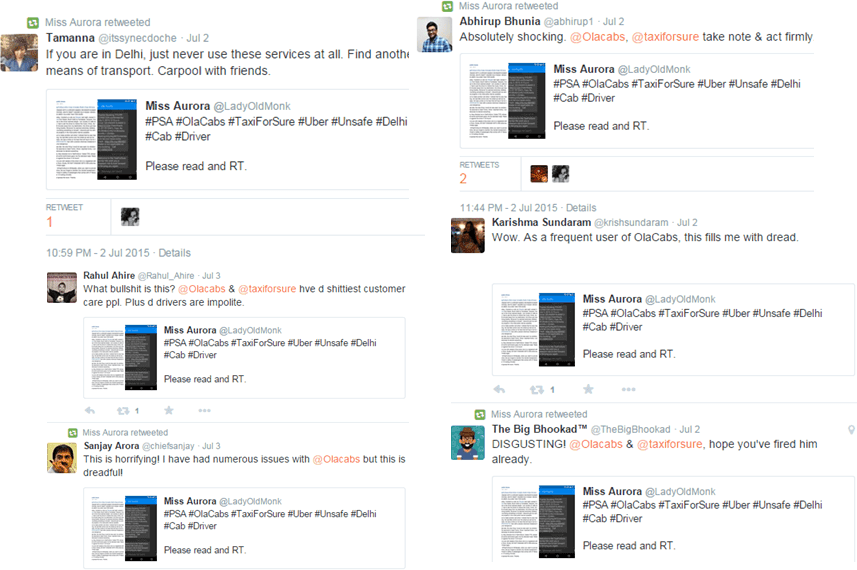
A woman accused ‘Taxi For Sure’ driver of Sexual harassment on July 02nd, 2015. She put her complaint out through Facebook & Twitter.

It gathered momentum online over the course of the day. Taxi For Sure responded to her tweet on the same day and contacted her offline as well. They also addressed posts by other supporters on the matter as well.


She continued to post her discussions with Taxi For Sure on social media and drive support.
The crisis situation was handled well in time by Taxi For Sure. The company responded immediately to the accused on Twitter and also reached out to her offline to settle the situation.
Interestingly, while the crisis broke on July 02nd, it was carried by the print media only on the July 07th. Of course Taxi For Sure was prepared and responded adequately – condoning the act, stating action taken and reemphasizing their focus/initiatives around passenger safety.
The news cycle died down both in print and social post July 08th.  

I believe, this is a great example of how crisis communication has evolved over time. When social media wasn’t in play, there used to be one way communication with the audience by the brand. Perhaps issuing a quote to the media and speaking to reporters to settle the situation was the only way to manage crisis.
However, with social media, brands can immediately have a dialogue with their audience and minimise the damage by reacting quickly.
What do you think are the best practices for dealing with crisis in the digital age? I’d love to know your thoughts!